—
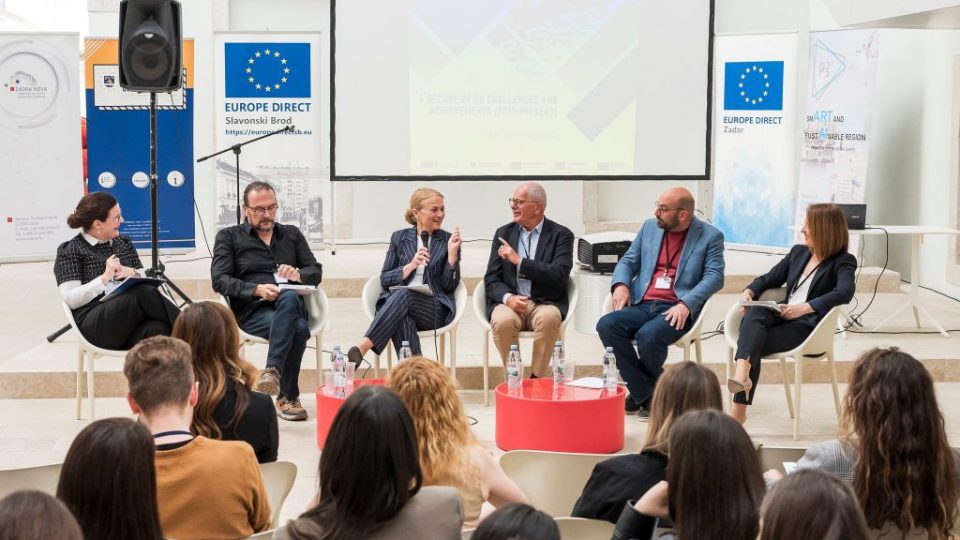
The conference *“A Decade of Challenges and Achievements of the European Union (2013–Present)”* was held on April 21, 2026, at Providurova palača in Zadar, organized by Europski dom Slavonski Brod and Europe Direct Slavonski Brod, with the support of the Representation of European Commission in Croatia and partner Europe Direct centres Zadar and Primorje-Gorski Kotar County. The event was implemented within the framework of the CERV – Past2Future project, with the aim of promoting active citizenship, strengthening civic participation, and encouraging inclusive dialogue on the future of the European Union. The conference gathered around 100 participants from nine countries — Albania, Bulgaria, the Czech Republic, Greece, Italy, Malta, Germany, Spain and Croatia — including representatives of EU institutions, academia, civil society, the private sector, and the general public, ensuring a diverse and multi-stakeholder exchange of perspectives.
The conference was opened by Iva Perić, while Jadranka Petek from Zadra Nova addressed participants on behalf of the host institution. The programme began with a panel discussion titled *“A Decade of Croatia’s Membership in the European Union: Challenges, Opportunities and Achievements”*, which provided a comprehensive reflection on Croatia’s experience since joining the European Union in 2013. The discussion brought together institutional, academic, and business perspectives, highlighting both the benefits and challenges of EU membership, as well as Croatia’s evolving role within the Union. The panel featured Zrinka Ujević, Head of the European Commission Representation in Croatia, Branko Baričević, former Head of the European Commission Representation in Croatia, Bruno Ćurko, Associate Professor at the Faculty of Humanities and Social Sciences, University of Split, Sven Marcelić, Associate Professor at the Department of Sociology, University of Zadar, and Ana Zubčić, representing the business sector, while the discussion was moderated by Marija Dušević.
A central and highly engaging part of the conference consisted of the Europe Café sessions, designed as six thematic participatory workshops that enabled participants to actively contribute to discussions and co-create recommendations on key European issues. The workshops addressed topics such as trade and global positioning, mobility and demographic trends, artificial intelligence and the future of work, security and resilience, democracy and citizen participation, and enlargement and international partnerships. Working in smaller groups, participants exchanged views and developed concrete proposals, including the need for faster and more efficient EU decision-making processes while preserving core values, improved access to mobility programmes and opportunities in smaller regions, stronger investment in digital skills, innovation and reskilling, as well as enhanced transparency and citizen participation in decision-making processes. Additional recommendations focused on strengthening resilience, media literacy and mental health support, as well as continuing the EU enlargement process based on fair and transparent criteria .
The results of the Europe Café sessions were presented during the final panel discussion, moderated by Srđan Kerčević, where group representatives shared their key findings and recommendations. This participatory approach ensured that the voices and ideas of participants were fully integrated into the overall outcomes of the event and highlighted the importance of inclusive dialogue and bottom-up contributions in shaping the future of the European Union. The final conclusions of the conference were presented by Maja Kuzmić.
Following the formal programme, participants took part in an interactive activity titled *Treasure History Hunting*, which provided an opportunity for informal networking, intercultural exchange, and learning about the cultural and historical heritage of the city of Zadar in an engaging and dynamic way. This activity further strengthened connections among participants and contributed to a collaborative and open atmosphere beyond the formal discussions.
Overall, the conference successfully combined expert insights with participatory methodologies, resulting in a highly engaging and well-attended event that directly contributed to the objectives of the CERV – Past2Future project. The event strengthened dialogue between institutions and citizens, encouraged active participation, and supported the exchange of ideas across sectors and countries. It also contributed to raising awareness of key European topics, fostering civic engagement, and promoting a shared understanding of the challenges and opportunities facing the European Union, thereby reinforcing the long-term goals of active citizenship, democratic participation, and transnational cooperation.